top of page

Portfolio
A snapshot of some of the impactful projects I've worked on over my career.
Project
Waste Diversion Strategy
Project Background
Company:
Explore Edmonton Corporation
Goal:
Improve waste diversion numbers at both the Edmonton EXPO Centre and Edmonton Convention Centre, using current Zero Waste Canada guidelines. Their goal was that 70% of the waste collected did not go to a landfill, but rather filtered into their appropriate recycling and repurposing streams.
Challenge:
With managing the diverse waste streams of Edmonton's two largest gathering spaces, the main challenge was transforming the in-venue operations around how waste was separated, audited, and tracked. There were very few formal measurement or reporting processes in place that could give my team discernible insights into the pre-event, active event, and post-event waste profiles.
Solution:
Several key operational changes were made that dramatically boosted Explore Edmonton's waste diversion numbers, including:
-
Decreasing the size of the landfill waste stream receptacles and prioritizing composting in the venue marketplaces.
-
Switching to all compostable packaging and utensils.
-
Tracking pre-event, active event, and post-event waste processes and procedures separately.
-
Conducting event-specific waste audits to determine how effective our signage and bin placements were.
-
Eliminating single-use items, such as creamers, sugar packets, and condiments.
-
Conducting full venue walk throughs with our junior zero-waste coordinator on a weekly basis.
Results
-
74.4% increase in total waste diverted from landfills
-
50% increase in event conversion rate
-
90% increase in organics composted from marketplace vendors.
.png)
Project
Net-Zero Roadmap
Project Background
Company:
AMNIe Management Consulting
Goal:
Nexif Energy, a large green energy provider operating in Southeast Asia/Australia wanted to reduce their electricity and gas consumption to lower their overall energy usage profile. Since they were a green energy company, they wanted to significantly reduce their reliance on generators and "Grey Energy".
Challenge:
The largest challenge presented to us during this project was understanding Nexif Energy's full profile of operations in Southeast Asia and Australia. Nexif provides electricity, gas, solar, internet, and home retrofitting to thousands of Australian consumers. Calculating scope 3 emissions across their wide array of product and service offerings presented a significant challenge because we had to dig really deeply into their supply chain. Also, the public scrutiny of land use made it extremely important to factor in community engagement.
Solution:
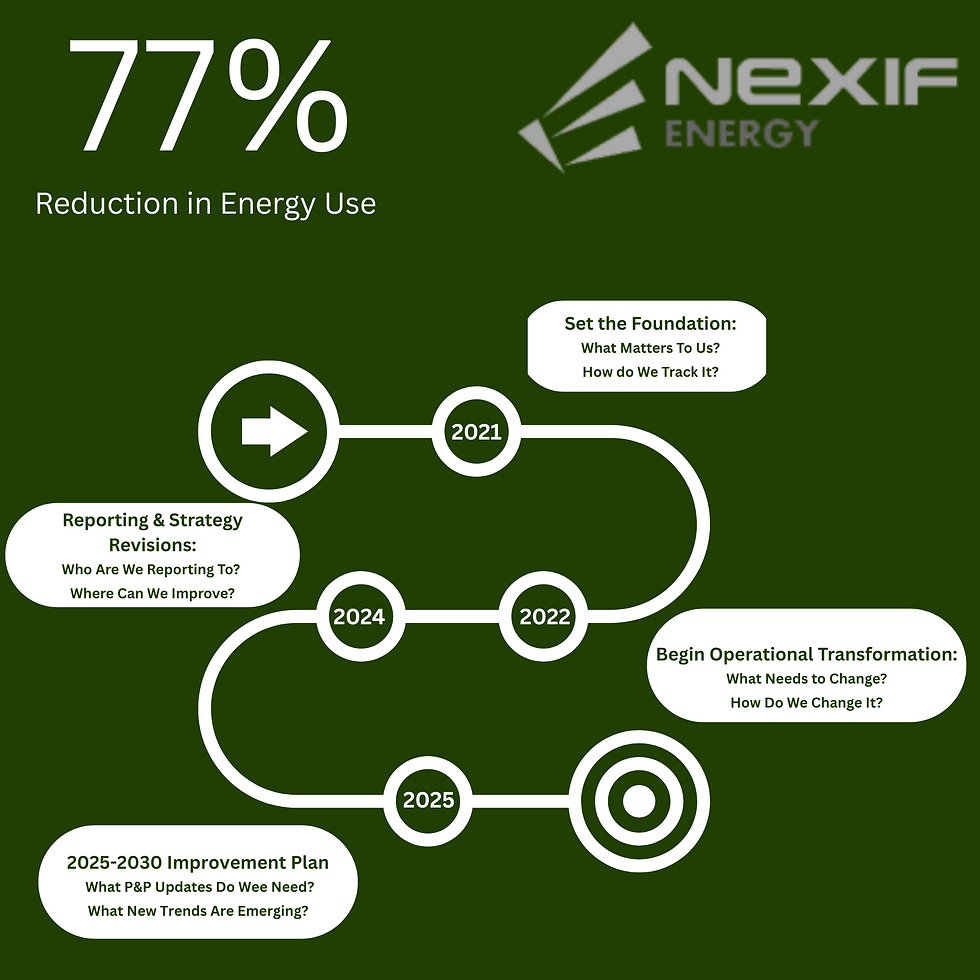
After exploring Nexif's scope 1-3 emissions profile and determining where the biggest areas of operational improvement were, we came up with a 5-year roadmap to net-zero that forecasted a 90% reduction in non-supply chain emissions by 2025. This roadmap included:
-
Process improvements
-
Equipment retrofitting
-
Data-driven energy usage insights
-
Bioreactor technology to monetize non-avoidable carbon production from smokestacks.
Results
-
77% decrease in total energy use at their plants and facilities
-
45% decrease in home services emissions (maintenance, repairs, etc)
-
Nexif was able to implement a long-term decarbonization strategy that made sense for their organization.
.png)
Project
Sustainability Reporting & Disclosure
Project Background
Company:
Novisto
Mission:
Novisto relied on its Account Development Managers to create realistic ESG reporting improvement strategies for clients using their data collection platform. Typically, I worked with enterprise level organizations with over 1,000 employees and multiple business units collecting ESG data.
Challenge:
While supporting enterprise clients at Novisto, I encountered several common challenges in improving ESG reporting strategies. Many organizations faced fragmented data systems, lacked standardized metrics, and operated under tight regulatory timelines. ESG teams were often under-resourced, and internal understanding of ESG’s strategic value varied widely. Navigating global reporting requirements only added to the complexity. I worked closely with clients to build tailored, scalable solutions that addressed both immediate needs and long-term goals.
Key challenges included:
Disconnected and inconsistent ESG data across departments
Limited internal ESG knowledge and executive buy-in
Time-sensitive compliance with evolving regulations (e.g., CSRD, SEC)
Resistance to transitioning from CSR to investor-grade ESG reporting
Difficulty aligning global operations with local disclosure requirements
Solution:
To address these challenges, I delivered targeted ESG reporting strategies that combined technical rigor with practical implementation. My approach focused on creating clarity, building internal capacity, and aligning ESG efforts with organizational priorities. I helped clients move from fragmented reporting practices to integrated, investor-ready disclosures that supported both compliance and long-term value creation.
Key solutions included:
Developed centralized ESG data systems tailored to client workflows
Created custom taxonomies and templates aligned with global frameworks (GRI, SASB, TCFD)
Designed phased implementation plans to manage timelines and resource limitations
Facilitated cross-functional education to strengthen ESG literacy and internal alignment
Advised on jurisdiction-specific disclosures while maintaining global consistency
Results
-
$1.5M in quarterly pipeline opportunity generated for Novisto
-
200% increase in data collection efficiency
-
60% increase in member retention
.png)
Project
Biodiversity Issues Management
Project Background
Company:
Explore Edmonton Corporation
Mission:
Maintaining a balance between our event operations and protecting the environment we share has always been a primary concern for Explore Edmonton. They wanted to present events with a way to help our native bee populations by sponsoring "Bee Hotels" that non-colony bees could use as temporary hibernation spots.
Challenge:
At the Edmonton EXPO Centre and Convention Centre, I led pollinator support initiatives through the installation of rooftop bee gardens and seasonal bee hotels. While both projects had strong environmental and community engagement potential, they came with distinct challenges. From logistical coordination to stakeholder buy-in, these initiatives required thoughtful planning and ongoing care to ensure they delivered real impact.
Key challenges included:
-
Identifying secure, low-disturbance locations suitable for pollinator habitats
-
Navigating internal approvals and vendor coordination for installation
-
Designing pollinator structures that were both functional and visually appealing
-
Creating a meaningful engagement strategy for event sponsors and public awareness
-
Ensuring long-term maintenance and seasonal viability of the gardens and hotels
-
Solution:
I approached these projects with a focus on ecological integrity, guest experience, and stakeholder value. For the rooftop bee gardens, I sourced native plants and worked with contractors to build a pollinator-friendly environment that supported solitary and hive bees. The seasonal bee hotel program, offered to events as part of our sustainability initiatives, gave clients a tangible way to support biodiversity. Thirteen events participated in its inaugural season, helping raise awareness while enhancing our venues' environmental leadership.
Key solutions included:
-
Selected and installed native flowering plants to create a safe, thriving rooftop ecosystem
-
Partnered with local experts to design attractive, durable bee hotels for event sponsorship
-
Integrated the program into the Responsible Events menu, offering clients an accessible sustainability option
-
Maintained seasonal routines for garden upkeep and communicated ecological benefits internally
-
Promoted visibility through strategic placement and storytelling, linking pollinator health to urban sustainability
Results
-
75% increase in event participation
-
13 events committed to supporting pollinators
-
50% increase in new event interest

Project
2024 GDSI Submission
Project Background
Company:
Explore Edmonton Corporation
Mission:
Explore Edmonton wanted to improve their Global Destination Sustainability Index score and maintain or improve their global ranking.
Challenge:
The GDSI is an organization that prides itself on meticulous scrutiny of multiple areas of destination stewardship. We had to highlight how our city's visitor economy operated as a whole when it came to sustainability initiatives and collaboration. The biggest challenge in this task was the amount of stakeholder engagement and industry outreach I had to conduct in order to accurately answer the questions GDSI were asking.
Some of the organizations I needed to collaborate with included:
-
Edmonton International Airport
-
Edmonton Unlimited
-
GoA (Government of Alberta)
-
CoE (City of Edmonton)
-
Edmonton Transit Services
-
EDMH
-
Downtown Restaurant Association
Solution:
To meet these challenges, I led a collaborative, research-driven approach that prioritized transparency, relationship-building, and mutual accountability. I engaged partners including the City of Edmonton, Edmonton International Airport, the Edmonton Hotel Association, and major tourism players to provide key data and insights. Through clear communication and well-organized outreach, I ensured the submission was comprehensive, credible, and aligned with the city’s broader regenerative tourism goals — ultimately helping Edmonton earn the #3 spot for most sustainable city in Canada.
Key solutions included:
-
Built strong relationships across public and private sectors to gather high-quality data
-
Created a structured outreach strategy with clear asks, timelines, and documentation needs
-
Facilitated knowledge-sharing between stakeholders to ensure consistency across responses
-
Verified data for accuracy and completeness before submission to GDSI
-
Positioned the submission as a tool for long-term destination improvement, not just a score
Results
-
Edmonton ranked 3rd most sustainable city in Canada
-
60% increase in new events booked
-
40% increase in industry outreach and collaboration
.png)
Project
Simple, Double, Dynamic Materiality Assessment
Project Background
Company:
AMNIe Management Consulting
Mission:
Improve clubs public reputation through people-centered communications campaigns
Challenge:
Supporting Nexif Energy in developing their roadmap to net zero required a deep dive into materiality — not only through a traditional lens but also through double and dynamic materiality perspectives. This work demanded a detailed understanding of evolving stakeholder expectations, climate-related financial risks, and the company’s operational realities across diverse energy markets. Aligning ESG priorities with business strategy while navigating data gaps and shifting regulations proved complex.
Key challenges included:
-
Aligning internal stakeholders around the differences between simple, double, and dynamic materiality
-
Identifying material ESG issues across multiple regions and business units
-
Incorporating emerging climate risks and regulatory frameworks into long-term planning
-
Balancing investor expectations with operational feasibility in energy transition pathways
-
Ensuring the materiality process informed — not just documented — strategic decisions
Solution:
I facilitated a comprehensive materiality process that began with foundational mapping and scaled into double and dynamic assessments tailored to Nexif’s evolving footprint. This included stakeholder interviews, ESG issue ranking workshops, and scenario-based risk modeling. I aligned the process with frameworks like CSRD, TCFD, and SBTi to ensure compliance and future readiness. The results directly informed Nexif’s net-zero strategy, with clear prioritization of transition risks, emissions hotspots, and region-specific opportunities for renewable integration.
Key solutions included:
-
Conducted tiered materiality assessments (simple → double → dynamic) for strategic depth
-
Engaged internal teams and external stakeholders to validate ESG priorities across the value chain
-
Integrated findings into a clear, actionable roadmap toward net-zero by identifying key transition levers
-
Aligned recommendations with global frameworks (CSRD, TCFD, SBTi) for regulatory preparedness
-
Created visual, executive-ready outputs to guide board-level decision-making
Results
-
+65% improvement in ESG reporting efficiency
-
Alignment to global frameworks
-
Created a science-based net-zero roadmap for Nexif Energy
.png)
Book your free strategy session now
bottom of page