Edmonton: Where Oil Patch Grit Meets Planet-First Innovation
- Adam Brennan-Smith
- Jun 18
- 4 min read


Edmonton has always been a city of builders, thinkers, and tinkerers. From early pioneers who engineered irrigation channels in the North Saskatchewan valley to the world-class researchers at the University of Alberta, this is a place that turns bold ideas into real change. It’s no surprise that Edmonton is now emerging as a powerhouse of sustainability innovation, where climate resilience meets community creativity. In 2025, the city’s green momentum is visible in everything from carbon-neutral communities to heritage streetcars humming on clean electricity.
Below are five of the most inspiring sustainability innovations happening right now in Edmonton.
1. Blatchford: Rewriting the Urban Blueprint
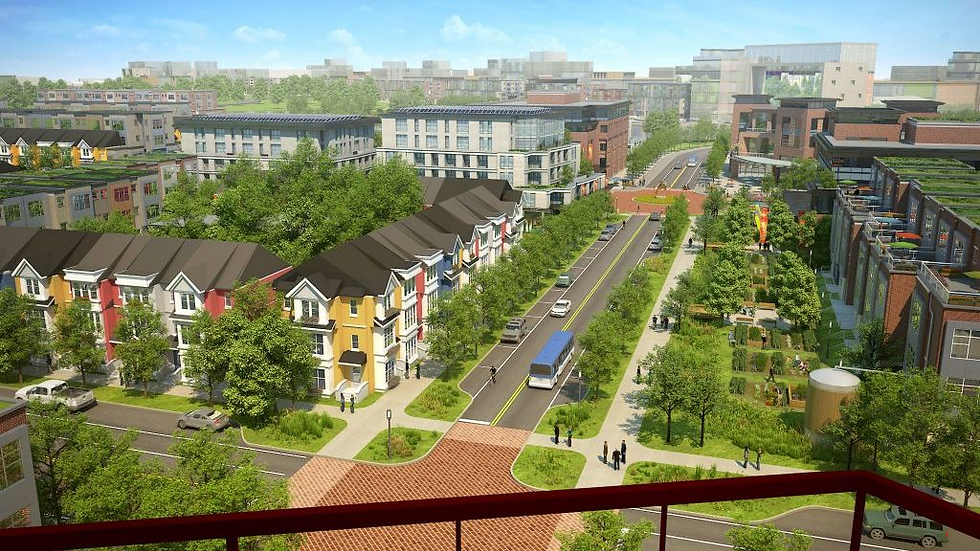
Once an airport, now a climate-forward neighborhood of the future—Blatchford is Edmonton’s flagship sustainability project. Spanning 217 hectares in the city’s core, it aims to be one of the largest carbon-neutral communities in the world, housing up to 30,000 residents.
At the heart of Blatchford is the District Energy Sharing System (DESS), a geothermal-based energy loop drawing from over 570 boreholes drilled deep beneath the stormwater lake. The ambient loop collects and redistributes heating and cooling energy between buildings year-round, supplemented by sewer heat recovery.
“We’re seeing greenhouse gas reductions of up to 75% below traditional designs,” said Ruben Arellano, Blatchford’s energy project manager. “It’s a system that shares energy like a co-op. When one building doesn’t need it, another can use it.”
Homes in Blatchford must meet stringent green building codes—at least 30% more efficient than Alberta’s standard—while future phases will include solar-powered net-zero housing and battery storage aggregated into a virtual power plant.
Sustainability doesn’t stop at energy: crushed runways were recycled into roads, hangars were carefully deconstructed, and bioswales and rain gardens help manage stormwater while supporting biodiversity.
2. Farmonaut’s Vertical Farms: Greens That Give Back

Imagine walking into a clinic and knowing your kale came from just down the hall. Edmonton-based Farmonaut, in partnership with Alberta Food Security Inc. and the University Hospital Foundation, is turning that vision into reality. Their compact, indoor farming modules use climate-controlled environments to grow pesticide-free vegetables with minimal water and zero emissions.
Each unit produces fresh food year-round and donates $1,000 of its revenue to healthcare research. It’s a sustainability trifecta—good for people, the planet, and our public institutions.
This project represents a growing movement in Edmonton: urban agriculture integrated into community infrastructure. Schools, hospitals, and commercial buildings are now being eyed as future hosts.
3. NAIT’s Heat Pump Lab: Decarbonizing in the Deep Cold

Heat pumps are key to phasing out natural gas—but can they handle -30°C prairie winters? Edmonton’s Northern Alberta Institute of Technology (NAIT) is finding out.
With funding from Alberta Ecotrust, NAIT has built one of Canada’s most advanced cold-climate heat pump test sites, evaluating both air-source and ground-source systems, including a unique below-building retrofit approach that could unlock emissions reductions for thousands of aging homes and offices.
The facility is helping policymakers and industry design retrofit strategies that are practical, scalable, and climate-proof.
“This work is going to be critical to Edmonton’s net-zero transition,” said a NAIT spokesperson. “If we can make it work here, we can make it work anywhere in Canada.”
4. The Edmonton Tool Library: Repair Culture for the Climate Age

The Edmonton Tool Library is a shining example of community-driven climate action. Open since 2016, it lets members borrow from a library of over 300 power and hand tools for just $50 a year.
By making tools accessible, the Library supports a circular economy—one where people repair, upcycle, and build rather than toss and replace. In a typical year, they help avoid hundreds of kilograms of waste, while also fostering a culture of self-sufficiency and shared responsibility.
“It’s about more than tools—it’s about empowerment,” says board member Kayla Pritchard. “You realize that you don’t need to own everything to live sustainably.”
5. Streetcars Go Green: The ERRS Electrifies the Past

Riding the High Level Bridge on a 100-year-old streetcar is a cherished Edmonton tradition. But did you know it’s also zero-emission transit?
The Edmonton Radial Railway Society (ERRS), which operates the city’s historic streetcars, won the 2024 Sustainable Tourism Award for their efforts to modernize their operations with clean electricity while preserving heritage. These lovingly restored trolleys now serve as rolling ambassadors for low-carbon transit, connecting locals and tourists alike to the possibilities of a greener city.
The group is now exploring battery storage and regenerative braking—making sure their historic fleet is as future-ready as it is nostalgic.
Edmonton’s Innovation Tapestry

What makes Edmonton unique is the ecosystem of innovation that spans government, non-profits, post-secondary institutions, startups, and citizen-led initiatives. Whether it’s reimagining entire neighbourhoods or building tool-sharing programs one wrench at a time, Edmontonians are co-creating a sustainable city grounded in community values.
In an era where climate action often feels abstract or out of reach, Edmonton offers a hopeful narrative: change is possible, and it’s already happening—block by block, lab by lab, harvest by harvest.
How You Can Get Involved
Visit Blatchford and tour the sustainable homes on site.
Join the Tool Library or donate your old tools.
Support local food systems by volunteering with urban farms.
Ride the High Level streetcar and share the story.
Follow NAIT’s research and consider a heat pump for your home.


Comments